3-2-1 Backup Strategy for Startups & SMEs | Secure Data, Zero Downtime
Why Startups & SMEs Can’t Ignore the 3-2-1 Backup Strategy
Data loss doesn’t knock politely. It hits without warning—one wrong click, one misconfigured cloud bucket, one ransomware link—and suddenly an entire business grinds to a halt. This is exactly why the 3-2-1 backup strategy has become a lifeline for startups and SMEs. In a world where digital operations move fast and margins are tight, losing even a single day of data can cause a chain reaction that is hard to recover from.
For growing companies—especially those without large IT teams—the risk is real. Many founders assume their systems are “safe enough” because they rely on a single external hard drive or a basic cloud backup. But traditional backups fail more often than people realise. Drives corrupt. Laptops get stolen. Misconfigured cloud folders accidentally share or erase files. And when ransomware hits, attackers don’t just lock your device—they often encrypt your backups too.
Pakistan’s business environment is moving through a significant digital transformation. From Karachi’s e-commerce startups to Lahore’s software houses to Islamabad’s consulting firms, companies are generating more data than ever before. Yet data protection remains one of the most overlooked aspects of business planning. In fact, studies from NIST show that most breaches succeed because organisations underestimate their backup vulnerabilities. This makes data loss prevention Pakistan 3-2-1 backup strategies more essential than ever.
What makes the situation even more challenging is how quickly threats evolve. Ransomware attacks have surged globally, and Pakistan is no exception. Cybercriminals know that SMEs are less equipped to defend themselves, and they exploit that weakness. With each year, the cost of an attack rises—not just the financial damage but the reputation hit, lost client trust, and endless recovery effort that follows.
Even accidental deletions remain one of the top causes of data loss worldwide. A single team member mistakenly removing a shared folder can wipe away months of work. Cloud misconfiguration is another silent killer. Many Pakistani SMEs rely on platforms like Google Drive or OneDrive without understanding that cloud sync is not the same as a Pakistani company backup strategy 3-2-1. When a file is deleted locally, syncing services often delete it everywhere else too. That’s not backup—it’s duplication with risk.
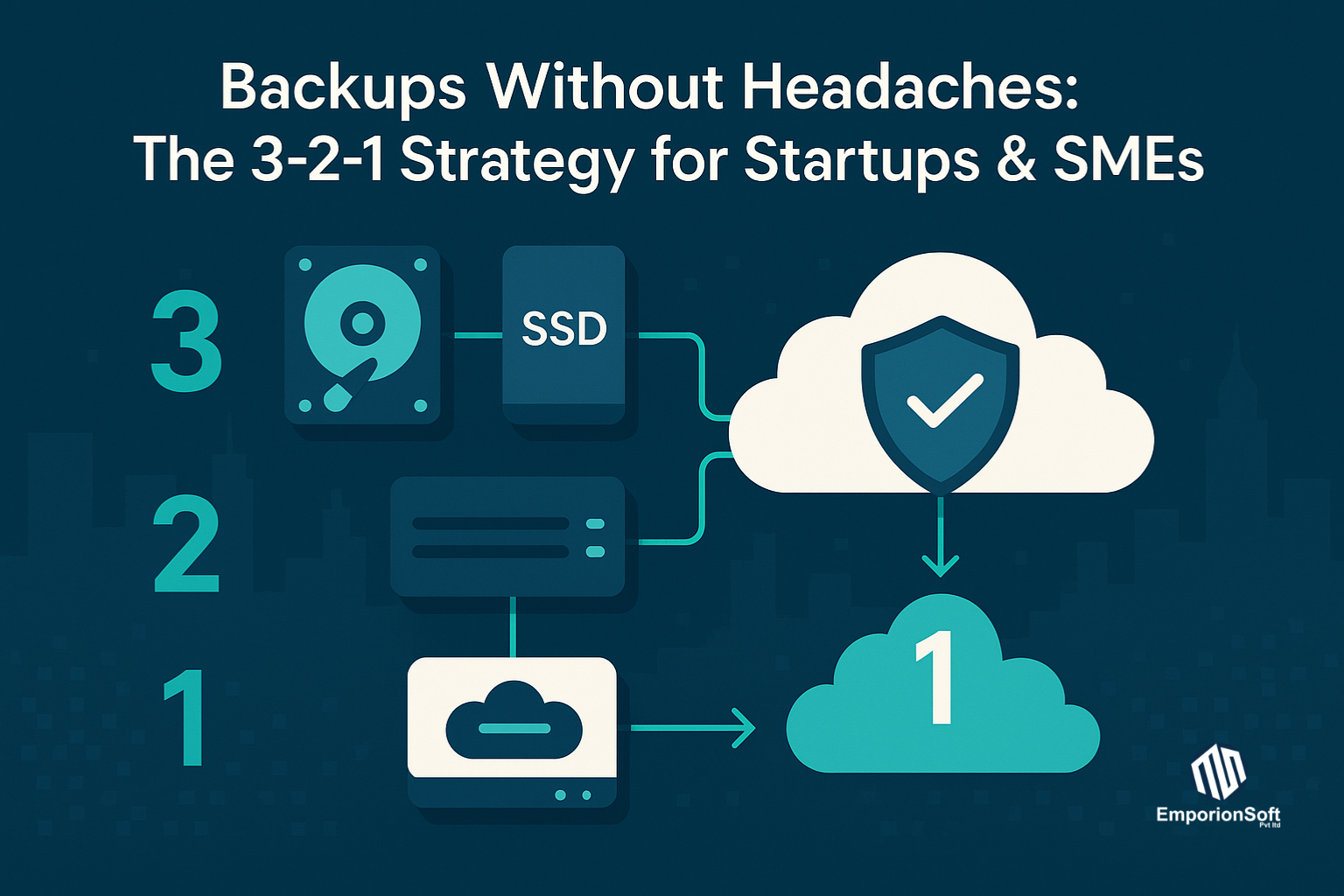
This is where the 3-2-1 rule steps in as the globally accepted gold standard. It’s simple, flexible, and designed for real-world failure scenarios. And unlike traditional single-location backups, the 3-2-1 backup strategy Pakistan model ensures your business has multiple layers of protection:
Three copies of your data.
Two different types of storage media.
One off-site location.
This framework works because it acknowledges that things go wrong at every level: devices fail, users make mistakes, networks crash, and bad actors find their way in. By spreading backup copies across different places and formats, you build a resilience system that mirrors how modern businesses operate.
For startups and SMEs in Pakistan, this approach also fits naturally with existing workflows. A company can keep one copy on local machines, another on an external drive or NAS, and a third off-site using a cloud provider. No complex infrastructure needed. No enterprise-level systems required. Just a structured approach to staying safe.
And when a business wants to scale or automate this setup, digital service partners like EmporionSoft—trusted for delivering future-ready solutions—can provide guidance on cloud integration, secure storage, and customised backup workflows. You can explore more about their expertise on the Services page or learn about the team behind these solutions on About EmporionSoft.
The bottom line is simple: modern businesses cannot afford fragile data systems. Whether it’s ransomware, accidental deletion, misconfiguration, or hardware failure, the threat landscape keeps expanding—and the only long-term defence is adopting a structured, reliable backup rule that doesn’t break when you need it most.
What the 3-2-1 Backup Strategy Really Means
The beauty of the 3-2-1 backup strategy lies in its simplicity. It breaks down the complex world of data protection into a practical, easy-to-follow structure that any business—from a two-person startup to a growing SME—can implement. Whether you’re running a digital agency, an e-commerce brand, or a SaaS platform, the logic behind the 3-2-1 backup rule Pakistan applies universally. It gives founders a safety net that actually works in real life, not just in theory.
At its core, the strategy is built around three copies of your data. The first copy is the live data your team uses every day. The second is a local backup stored on a different device, such as an external hard drive or a NAS system. And the third copy sits separately—ideally far away—acting as your ultimate line of defence. The idea isn’t to complicate your workflow but to prevent a single point of failure from wiping everything out.
These three copies ensure that even if something unexpected happens—a corrupt SSD, ransomware, a laptop crash, or a staff error—there’s always a fallback. Think of it as digital redundancy that mirrors how mission-critical systems operate worldwide.
The next part of the rule focuses on two different media types. This is where many businesses, especially in Pakistan, unintentionally weaken their protection. If all your backups sit on the same type of device, using the same storage method, you’re exposed to the same type of failure. For example, keeping everything on two USB drives sounds convenient, but both are vulnerable to corruption, theft, or physical damage.
Using varied backup media types Pakistan 3-2-1 rule—such as pairing a NAS with an encrypted cloud storage platform—reduces that risk significantly. It also helps guard against hardware-specific failures that can happen without warning.
Finally, the “1” stands for one off-site copy. This is arguably the most important part of the entire off-site backup Pakistan 3-2-1 strategy. If your business only stores backups in one physical location—say, in your office or store—then a single incident can destroy everything at once. Fire, flooding, theft, or even a power surge can take all local copies with it. An off-site or cloud copy ensures your data survives even when your physical environment does not.
Cloud services have made this step even easier. Most major providers offer encrypted, automated backups that run quietly in the background. Platforms like Google Cloud—which highlights best practices in its own Backup and DR documentation (Google Cloud Docs)—show why businesses globally depend on the 3-2-1 model for resilience.
The rule’s global success comes from real-world reliability. It doesn’t rely on a specific platform, toolset, or vendor. It’s adaptable for small budgets, scalable as companies grow, and practical for organisations that don’t have full-time IT teams. This is why giants like IBM, emerging startups, and local SMEs all use the same framework: it works everywhere, for everyone.
In Pakistan’s startup ecosystem, this reliability is even more crucial. Many SMEs operate in fast-paced environments with limited infrastructure. Internet outages, unstable power conditions, and rapid scaling can expose businesses to risks they weren’t anticipating. A new Lahore-based SaaS team, for example, might store live client data on laptops, keep a backup on a shared NAS in the office, and store the third copy in a secure cloud vault. If ransomware hits the local network, the cloud copy keeps operations running. If hardware fails, the NAS copy gets the team back on track in minutes.
Hybrid backups—blending cloud storage with local drives—offer the sweet spot for Pakistani businesses. They allow fast access through local copies, cost-efficient long-term retention in the cloud, and peace of mind knowing you’re not relying on a single method.
For companies exploring scalable data design or systems that work in real time, EmporionSoft’s insights in Real-Time AI in Production demonstrate how robust infrastructure underpins growth. You can also explore practical outcomes through real projects in the Case Studies section to see how resilient systems help businesses stay competitive.
Why the 3-2-1 Rule Is Still Relevant in 2025
The 3-2-1 framework continues to dominate best-practice recommendations because technology might evolve, but failure points haven’t disappeared. Hardware dies. Software glitches. Misconfigurations slip through. And cyber threats grow sharper every year. For startups and SMEs navigating Pakistan’s digital shift, a structure as consistent and adaptable as this rule remains the most dependable shield against unexpected loss.
About the Author
Published by EmporionSoft Pvt Ltd at EmporionSoft. EmporionSoft is a product engineering studio specializing in high-performance web applications, scalable architectures, and bespoke digital software.
Get our latest technical insights delivered directly to your inbox
No spam. Only high-fidelity deep dives on engineering, UI/UX systems, and product development practices.
Discussion (0)
Leave a comment
Your email address will not be published. Required fields are marked *